Construction material pricing is once again becoming a significant source of uncertainty for US project budgets. While cost pressures vary across commodities, recent data shows renewed escalation in steel, copper and other essential construction inputs.
For owners and developers, understanding these movements is increasingly important when establishing budgets, evaluating tenders and planning procurement.
Construction input costs are rising
According to an October 15, 2026 analysis by the Associated General Contractors of America (AGC), the Producer Price Index for inputs to new nonresidential construction increased 11.9% between September 2025 and September 2026.
The increase reflects pressure across several material and transportation categories, with metals and energy costs contributing significantly.
Importantly, these changes are not necessarily being reflected immediately in contractors’ tender prices. AGC noted that relatively soft demand across parts of the construction market has limited contractors’ ability to pass higher input costs directly to clients.
This creates a potentially challenging environment in which underlying project costs can increase even when headline tender inflation appears comparatively moderate.
Steel: renewed pricing pressure
Steel has experienced some of the most significant price increases.
US Bureau of Labor Statistics data for September 2026 shows that steel mill product prices increased 27.6% year-on-year.
The implications extend beyond structural steel frames. Steel is also used extensively in reinforcing, metal decking, fabricated components and equipment.
Projects with substantial steel content may therefore face increased exposure, particularly where procurement occurs well after initial budgets have been established.
Availability is another concern. AGC has highlighted lengthening delivery schedules for certain steel components, creating additional challenges for construction sequencing.
Concrete: a different cost profile
Concrete pricing has followed a different trajectory.
September 2026 producer price data indicates that concrete product prices increased approximately 4.2% year-on-year, while concrete ingredients and related products rose 4.3%.
Although these increases are more moderate than those recorded for steel, concrete remains sensitive to local market conditions.
Transportation distances, aggregate availability, labor, reinforcement and regional demand can all influence delivered and installed costs.
For major developments, understanding the difference between national commodity trends and actual local subcontractor pricing is essential.
MEP: equipment and supply chain exposure
Mechanical, electrical and plumbing systems represent a substantial proportion of construction costs across many technically complex building types.
Recent price movements illustrate the importance of tracking individual equipment categories rather than applying a single MEP escalation rate.
September 2026 producer price data recorded:
- Air-conditioning and refrigeration equipment: +5.7% year-on-year.
- Nonferrous wire and cable: +23.0%.
- Copper and brass mill shapes: +30.0%, according to AGC’s analysis.
These movements can have important implications for healthcare facilities, laboratories, data centers and other buildings with significant mechanical and electrical infrastructure.
Equipment availability, specification requirements and procurement timing can create further differences between published price indices and actual project costs.
Why commodity indices are only part of the picture
Producer price indices provide valuable insight into market direction, but they are not a substitute for project-specific pricing.
The final installed cost of a construction package also reflects fabrication, labor, productivity, transportation, contractor overhead, risk and market competition.
For example, a significant increase in the price of steel mill products does not mean the installed structural steel package will increase by the same percentage.
Owners should therefore combine published indices with current supplier quotations, trade market intelligence and detailed cost analysis.
Turning market intelligence into better budgets
The most effective approach is to understand which cost categories create the greatest exposure for a particular project.
This includes identifying material-intensive packages, monitoring procurement lead times and regularly updating estimates as market conditions evolve.
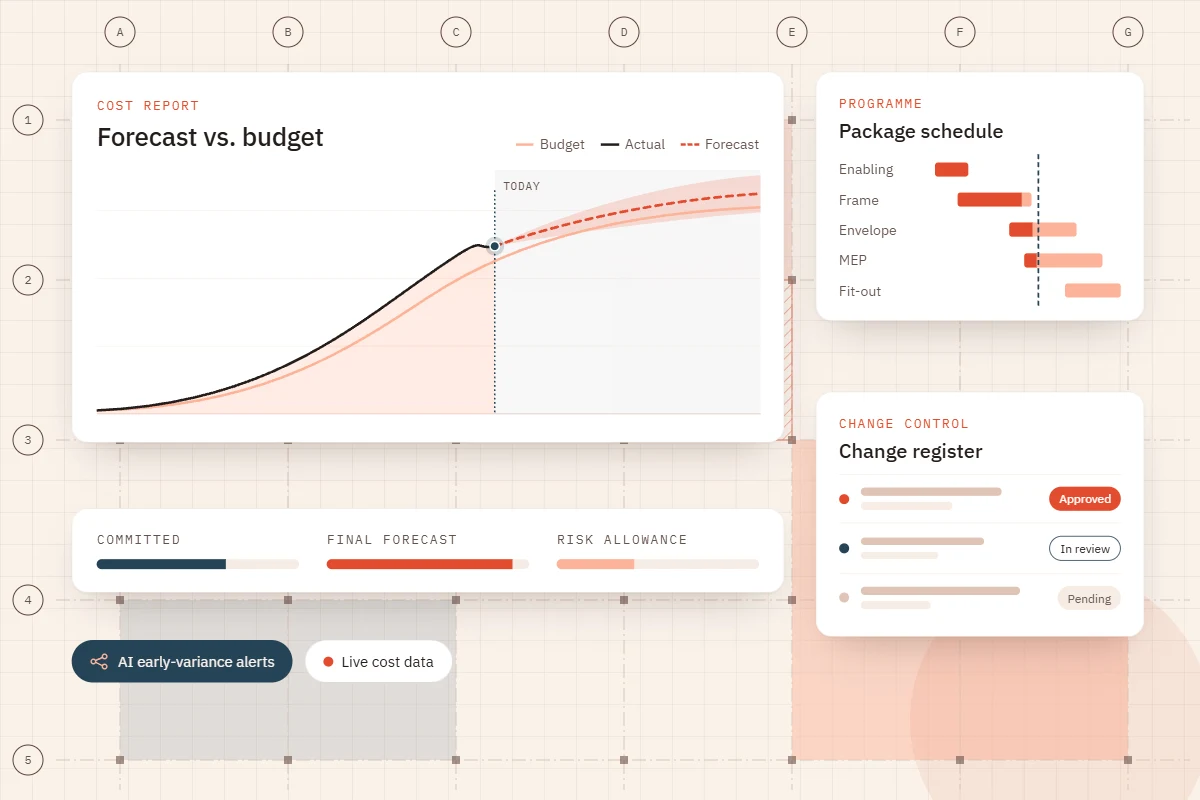
DHARAMetrics provides a framework for connecting historical project costs with current pricing intelligence, enabling more consistent benchmarking, cost modeling and analysis of changing market conditions.
Looking ahead
Material price volatility reinforces the importance of maintaining current cost plans throughout the project lifecycle.
Rather than treating escalation as a single allowance applied at the outset, owners should continuously assess how market movements affect individual work packages.
The Dharam perspective
Reliable construction budgets depend on understanding what is changing, where the exposure lies and when procurement decisions must be made. Combining market monitoring, detailed estimating and proactive project controls helps owners respond to pricing uncertainty with greater confidence.